


Georgetown, South Carolina

Denver Snowfall AE x Bali Sunrise AE

Denver Snowfall AE
Sire
Denver Snowfall AE (F6) Bengal TICA®️
(Wildgembengals Ghiaccio Oftld x The Leopards Den Pony Girl)
Silver BG
Born: 8 /16 / 2022

Bali Sunrise AE
Dam
Bali Sunrise AE (F1) Bengal TICA®️
(Hayden - ACL x Winter of Unique Prints - F6)
Brown BG
Born: 8 /25 / 2024

Available Kittens Coming Soon
Sharing the love, passion, and experience of our beautiful Bengal.
Please do your research they are an amazing lifetime experience and all in commitment.
Tons to learn but we are here to help anytime with your questions.
So much love and time goes into them thank you for your understanding.
What is a Bengal?
Breed Overview
PERSONALITY: Affectionate, energetic, and animated.
WEIGHT: Up to 15 pounds but generally about 12 pounds
LENGTH: Up to 18 inches
COAT LENGTH: Short hair, Long hair (variant)
COAT COLORS: Brown tabby, seal sepia tabby, seal mink tabby, seal lynx point, black silver tabby, seal silver sepia tabby, seal silver mink tabby, and seal silver lynx point
COAT PATTERNS: Spotted or marbled
EYE COLOR: Green or gold
LIFESPAN: Up to 20 years
HYPOALLERGENIC: No
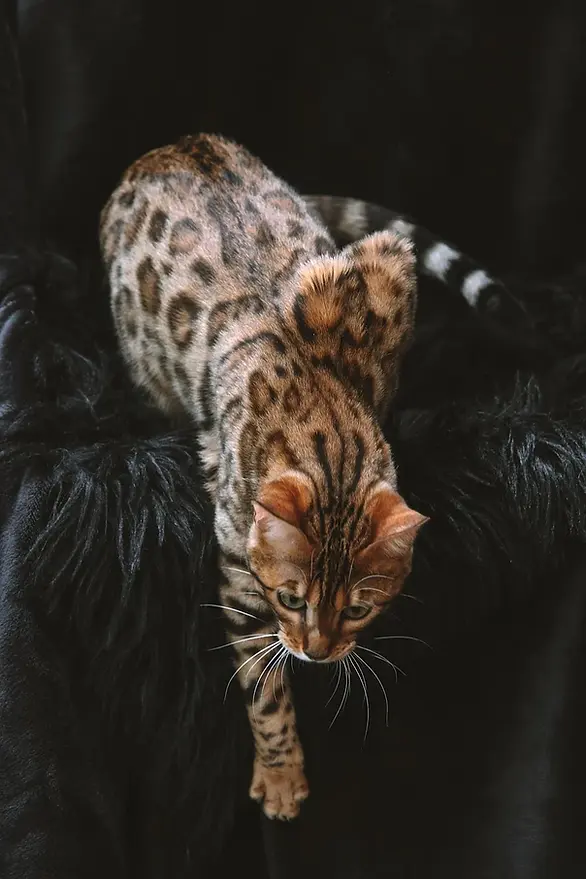
Bengals are large, muscular cats with long faces and large ears. Most are short-haired, but there is a long-haired variant. The Bengal breed is not considered hypoallergenic.
Bengals are best loved for their wild-looking markings. Rosettes, marbling, spots, and stripes make up the leopard patterns that varying Bengals display, but their official markings are only spotted or marbled. The patterns are always outlined in black, chocolate, or grey/silver.
Bengal coat colors are called brown tabby (most common), seal sepia tabby, seal mink tabby, seal lynx point, black silver tabby, seal silver sepia tabby, seal silver mink tabby, and seal silver lynx point. All shades of brown to black make up the markings and the brown tabbies typically have white background fur on their whisker pads, chin, chest, abdomen, and inner legs. Bengals' eyes are green or gold.
ORIGIN: United States


History
Cat fanciers began experimenting with Asian Leopard cat hybridization more than 200 years ago, but the Bengal cat we know and love today didn’t emerge until the 1960s, when Dr. Willard Centerwall of Loma Linda University began hybridizing Asian Leopard cats to see whether they would pass their immunity to feline leukemia on to hybrid offspring. While immunity wasn’t passed on, something great did result from those early experiments: the beginnings of a future new cat breed.
It took decades for Bengal cats to become standardized. In 1980, Dr. Centerwall sent some of his Bengal cats to Jean Mill, who wanted to decrease the desire for fur as a fashion statement by popularizing domestic cats with exotic looks. At the same time, she hoped to reduce the demand for illegal trafficking in wild cats for the pet industry.
The breed was further developed with the addition of Tory of Delhi, a domestic street cat that was imported from India. Other breeders discovered that Egyptian Mau cats were excellent candidates for pairing with Asian Leopard cats, with the cross resulting in beautiful spotted Bengals.
The International Cat Association (TICA) recognized Bengal cats as an experimental breed in 1983, and full recognition was gained in 1993. The Cat Fanciers' Association (CFA) granted the Bengal breed its official recognition in 2016.